
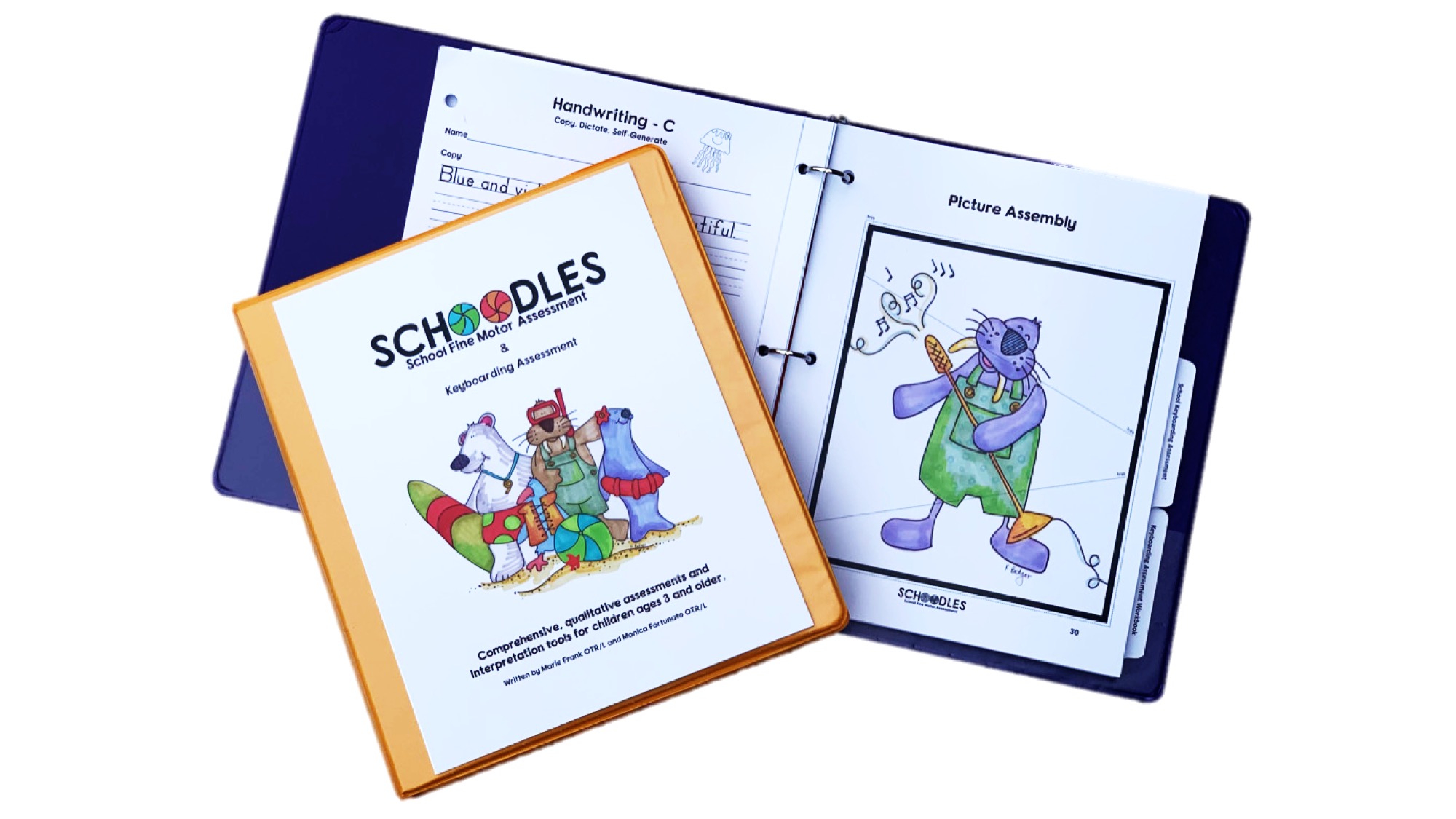
Skills are categorized into Classroom Skills and Supporting Skills, those skills needed to support fine motor outcomes.
Classroom skills include design copy, handwriting, coloring, cutting, and puzzle construction. Supporting skills include manual muscle testing, proprioception, gross motor coordination, eye-hand coordination, finger coordination, crossing midline, motor planning, bilateral coordination, trunk strength, and vision skills.
Observations made from these tasks are analyzed to determine if there are need areas that can be addressed by an occupational therapist.
Goals can be easily written from the information gained from the assessment using the goal writing guide. The assessment process takes about 30-45 minutes to complete.
Skills are assessed according to age levels of attainment and quality of performance, allowing for an individualized approach to each student's specific challenges.
Skills are categorized into three areas, Play Skills, Classroom Skills, and Supporting Skills, those skills needed to support fine motor outcomes.
Play skills include skills that assist in fine motor skill development such as nesting, stacking, toy assembly, puzzle, peg board, bead stringing, and block design.
Classroom skills cover design copy, handwriting, coloring, drawing and cutting.
Supporting skills include manual muscle testing, proprioception, gross motor coordination, eye-hand coordination, finger coordination, crossing midline, motor planning, bilateral coordination, core strength, and vision skills.
Observations made from these tasks are analyzed to determine if there are need areas that can be addressed by an occupational therapist.
Goals can be easily written from the information gained from the assessment using the goal writing guide. The assessment process takes about 30-45 minutes to complete.
Areas needing intervention requiring the unique skills of an occupational therapist can be identified.
The assessment includes a Background Information Form, a Teacher Question Form, a Student Question Form, and a detailed Record Sheet. Typing samples to copy, links to timed tests, and links to keyboarding programs for intervention are also included.
We use the same cost-effective reproducible format we use in the original Schoodles assessment.
The keyboarding membership offers fillable forms and individual workbook pages to customize your assessment to the student. One-time purchase, lifetime access includes any updates or changes we make to the tool.
The assessment includes:
- A detailed rubric that calculates legibility as a percentage based on key components.
- Three comprehensive sample assessments.
- Grade-specific handwriting expectations.
- A Google Forms-based teacher interview.
- A quick start guide for seamless implementation.
- A student rubric to empower self-assessment.
- A report template available in Google Forms for streamlined documentation.
- A guide addressing special population considerations.
- A service delivery decision guide to assist in planning.
The QLM can be completed in just 10 minutes. Add this effective resource to your assessment tool kit.
This is a one-time purchase that grants access to all materials, updates, and additions. District-owned memberships can be transferred in the case of a resignation followed by a new hire, with one membership per user. For additional details, please refer to the Terms of Use statement.
Students learn to identify specific changes they can make to increase consistency and readability of their work. The use of consistent practice, increasing memory skills, incorporating activities into the classroom and developing skills that can be used more broadly are all embedded into this program.
While the basic program is easily used on it's own, we have included an accompanying guide filled with evidence based strategies to address a variety of needs for students with ASD, ADHD, DCD, FAS and LD.
Hundreds of students have successfully and quickly increased the legibility of their handwriting through an earlier version of this program.
Anyone interested in helping students increase legibility can use this program, including home school parents, teachers, and occupational therapists.
Memberships are offered as an annual membership, or a lifetime membership and are one per therapist/user and include anything new we add. A download of the program in comic book form is available as well. Group pricing is available .
About Digital Memberships
Memberships give the Schoodles team the ability to add new research, new products and updates, and incorporate feedback from therapists. 'Where do I start' instructions and quick start guide are just some examples of feedback included to get you up and running quickly for remote or in-person assessments. They give the therapist the perfect grab-and-go tool.
A criterion-referenced chart with over 30 fine motor skills organized in a developmental progression is included along with training videos for therapists, task videos for students, and fill-able forms to use on a tablet or computer.
A new report writing template with drop downs, narrative prompts and templates for other frequently used tests to make report writing fast and easy. Reports can be written in under an hour and emphasize parent friendliness and student strengths.
Digital memberships are a purchase once option. NO Yearly Membership Fees.
We are constantly adding new features! Watch the scroll box on the homepage for updates!
Choose both the hard copy and digital membership for ultimate flexibility and access to new information.
*Memberships are one per therapist. Contact [email protected] for quotes.
About the Webinars
This webinar is designed for occupational therapists—especially those working in school or pediatric settings interested in refining their skills in fine motor assessment. The presenters draw on their strong background in school-based OT and their experience developing the Schoodles School Fine Motor Assessment Tool to guide participants through:
-
Core principles of fine motor evaluation
-
Observation-based strategies
-
Using qualitative data
-
Translating assessment findings into functional goals and interventions
- Follow a case study from initial referral to write-up
Certificate of participation upon request
This course will guide occupational therapy Practitioners in assessing fine motor skills by focusing on five often-overlooked areas that provide critical insights into a student's needs and strengths. Participants will learn how to incorporate these key areas into evaluations and reports to better inform intervention strategies.
Practical techniques for gathering and applying this information will be shared, empowering OTPs to enhance their assessments. The one-hour presentation offers actionable steps to improve understanding and support of students in school settings.
Objectives:
1. Identify five essential areas to include in an evaluation that are often overlooked in assessing fine motor skills.
2. Describe practical techniques for collecting relevant information during the evaluation process.
3. Distinguish between motor-based issues and learning challenges when interpreting handwriting outcomes.
Contact Hours
This course is 1 hour in length. (0.1 AOTA CEUs)
About Criterion Referenced Checklists
Schoodles is a qualitative, criterion-referenced assessment designed to provide practical and targeted insights into a child's fine motor skills for intervention planning and progress monitoring. As a criterion-referenced tool, Schoodles focuses on a child's mastery of specific skills rather than comparing them to normative data. While not a standardized, norm-referenced assessment, its value lies in guiding individualized goal setting, tracking progress, and informing functional intervention strategies based on direct observation."
Understanding Criterion-Referenced Assessments (CRAs) :
Focus on Mastery: CRAs compare a child's performance against a set of predetermined criteria or standards, rather than comparing them to other children (which is what norm-referenced assessments do). This means you're looking at whether a child can perform specific skills, regardless of how they compare to their peers.
Clear Information on Skills: CRAs excel at providing specific information about what a child can or cannot do. This is incredibly useful for identifying areas of strength and areas that need intervention.
Program Planning and Progress Monitoring: Because they focus on specific skills, CRAs are excellent for setting individualized goals, planning interventions, and tracking a child's progress over time towards those goals. They can show if a child is mastering the skills necessary for school or daily life.
Value of Schoodles:
Schoodles uses age levels derived from research-based sources. While it may not have extensive published psychometric data (like reliability and validity coefficients typically found with standardized, norm-referenced tests), it still offers significant value:
Clinical Utility and Practicality: Directly Relevant to Functional Skills: Schoodles focuses on school-based fine motor tasks (handwriting, coloring, cutting, etc.) and supporting skills. This makes it highly practical for occupational therapists in school or clinical settings who need to understand a child's performance in real-world contexts.
Observation-Based: Observation is a cornerstone of pediatric assessment. Checklists guide systematic observation, ensuring that a broad range of skills are considered.
Efficient: Tools like Schoodles aim to be efficient, providing relevant information in a reasonable timeframe (e.g., 30-45 minutes).
Goal Setting and Intervention Planning: The clear, criterion-referenced nature of these checklists makes it easy to identify specific skill deficits and then formulate measurable goals and intervention strategies. Schoodles specifically highlights its utility for goal writing and "next steps" in skill development.
Qualitative Information: While not generating standardized scores, these tools allow for rich qualitative observations about how a child performs a task, including their effort, strategies, and contributing factors (e.g., posture, motor planning).
Addressing Specific Needs: Individualized Approach: Since it's criterion-referenced, you can tailor the assessment to the individual child's specific needs and areas of concern, rather than administering a fixed battery of tests.
Strengths-Based Assessment: Schoodles criterion-referenced tools can effectively identify a student's strengths alongside areas for improvement, promoting a more positive and empowering assessment approach.
Best Practice:
Often, the most comprehensive assessment approach combines different types of tools: Norm-referenced assessments can provide standardized scores for comparison to peers, helping to identify significant delays or impairments.
Criterion-referenced checklists (like Schoodles) and other informal observations provide rich, specific information about functional skills, strengths, and challenges, guiding intervention.
Parent/caregiver and teacher input offer crucial insights into the child's performance in different environments.
Schoodles provides critical information for individualized goal setting, intervention planning, and progress monitoring, especially when the focus is on a child's mastery of specific functional skills. However, be mindful of its limitations, particularly when standardized comparisons or strong statistical justification are required. Integrating it with other assessment methods often provides the most complete picture of a child's fine motor abilities.